Saturday, May 31, 2014

The No-Name Sewing Machine

A lady dropped off a sewing machine last week. She said it didn't sew, she had tried to sell it and got no takers, so I could have it for parts. This was my first view - a plain, white generic plastic carrying case.  I wonder what kind of machine is in there...


Well, that's unusual, a sewing machine with no obvious badge or manufacturer's name.


Maybe it's on the back...Nope, nothing


I'll tip it over, there's bound to be a manufacturer's logo or JA number...Nope, nothing there, either.


I'm sure it will be on the serial number plaque - Nope, nothing there but a serial number.


Here's the only identification information - a tiny sticker saying, "Made in Taiwan".


Tipping it over to look at the serial number, I noticed that the bobbin case was not installed properly.  That could be why it doesn't sew.


Removing the bobbin case and shuttle, I spied red thread behind the shuttle. Maybe that's why it doesn't sew.


There was a serious burr on the point of the hook, so bad that fine abrasive wouldn't take it off.  I had to clean off the burr with a file, then polish with the fine abrasive.

After oiling, I threaded it up to test sew. First thing I noticed was that the tension did not release when the presser foot was raised. The paddle that presses the tension release pin on the back side of the tension assembly appears to be bent.


I tried to bend it back without removing the whole light/needlebar/presser bar/swing assembly but couldn't get it where it needed to be.  If I couldn't make the paddle reach the pin, maybe I could make the pin reach the paddle.  I disassembled the tension assembly and removed the pin from the front and cut a same-diameter finish nail to about 2-3mm longer than the original pin, that has worked for me in the past.


That still wasn't long enough, I guess I'll have to continue turning tension to '0' to thread the needle until I figure something else out or find a longer finish nail or bite the bullet and remove all the mechanicals to get at that paddle.

On the first test run, it sewed pretty well - a bit noisy, but changing the orange, toothed tractor belt for a smoother version quieted it down significantly.


 I learned that it is a left-needle zig zag machine, at '0' stitch width, the needle sits at the far left end of the hole in the throat plate; as stitch width is increased, the needle swings farther and farther to the right. That configuration makes it tougher for a quilter to judge a quarter-inch seam but having the fabric supported on three sides in straight stitching mode reduces the possibility of the fabric getting sucked down under the needle plate.

Now, I need to use it on a project to see how it performs in the long run.

Ed
Ed's Vintage Sewing Machine Shop

Friday, May 23, 2014

Kenmore 1720

  Last week, a lady called having a problem with her Kenmore Ultra Stitch 12.  When I went to pick it up, she had a second machine belonging to a friend, a Kenmore 1720.


  She said there was nothing wrong with it, it just needed cleaning and oiling.  The machine looks very well cared for and little used but it had a very loud clanking sound when operated.  Except for that noise, the machine ran smoothly and, with the bobbin case /shuttle removed, very quietly so I was pretty certain where the noise was originating from.  I opened up all the panels and oiled everything and, while doing that, found some thread wrapped around the knuckle of the thread take-up lever.

 
  Here's where it gets goofy - AFTER I removed the thread, the machine locked up so tight that the motor wouldn't turn it over and it was difficult to rotate by hand!  I looked for additional thread clogs and re-oiled evrything with no improvement. To isolate, I disconnected the connecting rod that transmits movement from the main shaft to the lower section.


  This cuts the mechanism in half and tells me whether the problem is in the upper or lower section.  It was in the upper section.  Having exhausted all my ideas, I doused the whole upper section with Liquid Wrench and let it sit overnight.  This morning, it seemed a bit looser turning by hand and, after a few revolutions, the motor took over and spun the shaft. I ran in the machine at top speed for about a minute and all the binding is gone.  I have no idea where the problem was.

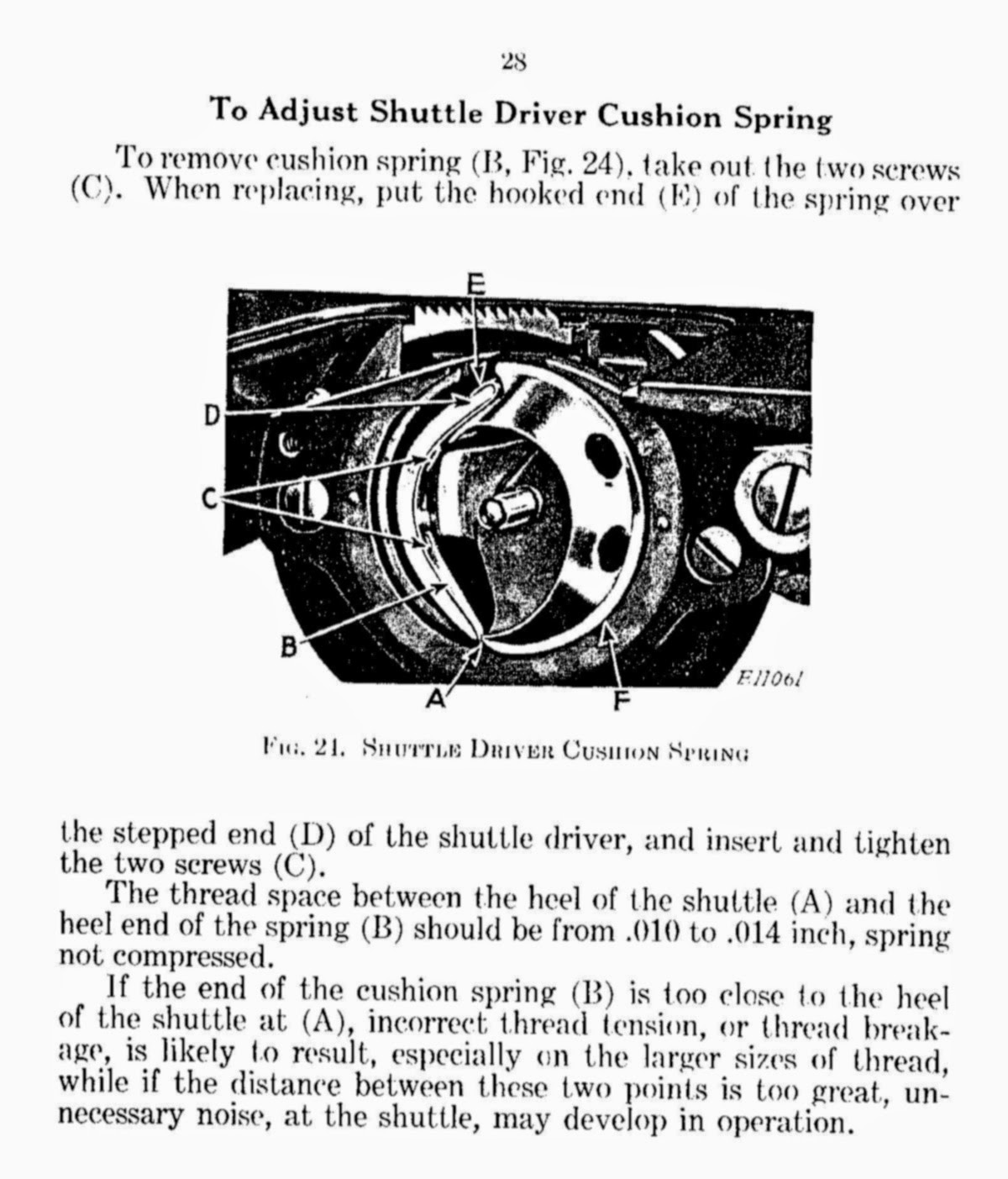
Then on to the noise in the shuttle area.  The thread gap between the tip of the shuttle cushion spring and the shuttle should be just over the thickness of thread but this one was a good 1/8 inch.

  That explains the noise!  I went to bend the cushion spring to narrow the gap and found that there was no end - the end of the spring had broken off.


I rummaged through all my parts bins and could not find a single cushion spring. Apparently, that is something that needs replacing so seldom that I haven't kept any spares.  Then I remembered the Julia I am parting out still has the cushion spring so I cannibalized it but it is too long to work in the Kenmore.  Fortunately, my parts source has the springs and attaching screws in stock, so I can order replacements.

Ed
Ed's Vintage Sewing Machine Shop

Saturday, May 10, 2014

Singer 29-4

We had a community yard sale last weekend and I made a landfill contribution on Friday.  I now have a clear path to my 29-4 Shoe Patcher.


  I picked this machine up at a local auction for $25 but would have paid $50 for someone to load it into my minivan for me - It is a MONSTER!  I was surprised to get the machine that sells in the $400 range on Ebay for such a low price, especially because it is treadle-operated and there were several Amish bidders in the house.
  The decals are not complete, but more prevalent than many because these machines were used in shoe factories and saw a lot of use.


  I took the machine home and put it in the storage shed, intending to get to it later - I never did.  When we moved to our present house four years ago, I put it in the garage and piled lawn furniture, bicycles, yard working equipment, and a table saw in front of it and have never dug it out to tinker with it.

  I hope it works because Kathie bought a carrying case for her Janome Jem


and one end of the zipper did not get caught in the sewing process.


I tried to repair it on a flatbed machine but just can't get the fabric to lay down flat enough to sew it.  I have tacked it by hand for now but would like to effect a permanent repair by machine and the 29 is the only machine I have that might do the job. It has a narrow free arm and the feeding foot rotates to feed the fabric in any direction.


Ed's Vintage Sewing Machine Shop


Monday, April 21, 2014

Lower Tension Adjusting

My Necchi Lelia was giving me some loose stitches yesterday.  Adjusting the upper tension and presser foot pressure had no effect, so I pulled out the bobbin case and checked the tension on it. I have a spring tool that supposedly tells the proper upper and lower tensions 


but I have used it before and am not happy with the results. 
Tension always seems way too tight after adjusting to the tool's marks. 

I read somewhere on the internet that proper Class 15 bobbin case tension could be found by filling a bag with just under 1 1/2 ounces of sugar and hanging that bag of sugar from the bobbin thread.  Not wanting to keep a bag of sugar around to invite ants, I opted for a bag of metal washers instead.


I broke out my cheap-o balance scale 


and measured out 1 1/2 ounces of washers and put them in a zip-lock bag.


Adjust the tension screw on the bobbin case until the bag of sugar slowly drops. If the bag stays suspended, tension is too tight; if the bag drops like a rock, tension is too loose.  


When you have the adjustment just right, re-insert the bobbin case in the machine and adjust upper tension to achieve a balanced stitch. 

I adjusted the Lelia's bobbin tension until the bag dropped slowly and put the bobbin case back in the machine. Stitches were ALMOST perfect, maybe just a tiny bit tight - I had to increase upper tension to '5' to balance the stitches but it gives me a starting point. I will remove washers from the bag one-by-one until I have a measuring device that gives me the result I want.

My next thought is to use some of that left-over spring wire to make a homemade tension scale.


Ed

Saturday, April 19, 2014

Spool Holders

If you have a vintage Singer Touch & Sew, you probably have noticed that the spool holders have lost the foam pads that hold the thread spool from spinning and rattling.


Replacement pads are available,


but I am always looking for ways to re-use something around the house, rather than buy new.  When we got our new family room furniture, I went to Wal-Mart and picked up a package of 1 1/2 inch felt pads to protect the hardwood floors from scratches. 


There are still about 10 felt pads remaining in the package and they looked about the size of the spool holder pads, so I decided to give it a try.

Using my 50-year-old high school geometry knowledge, I got out a compass and marked the center of the felt pad. 


Then, using the largest adapter on my leather punch,


I punched a hole exactly in the center of the felt pad.


I cleaned the remaining sponge from the spool holder


and mounted the peel-and-stick pad to the spool holder.

And here it is, all ready to go. 


Now I have to look through my stash of felt pads to see if there is one the correct size to renew the small spool holder.

Ed

Ed's Vintage Sewing Machine Shop

Saturday, April 12, 2014

Foot Control

Kathie and I took a day trip to Fredericksburg, Virginia today.  As usual, we hit all the fabric stores and quilt shops for Kathie and thrift shops for me.  In one Goodwill, I spotted a like-new foot control for $2.99.


 Because I'm too lazy to fix up the tub of foot controls in the shop, I am always happy to pick up a working model.  I looked at the power cord and saw that it was a three prong grounded type.  That's good.


Then I looked at the cord that hooks to the sewing machine to see if I knew what machine it came from and saw that it has a three prong socket at the end of that cord.


  It is not a sewing machine foot control at all, it is a speed control for any motorized piece of equipment.  Well, a sewing machine is a piece of motorized equipment, isn't it?  I now have a "shop foot control" to test any machine having the motor & light block type of hookup.



 Just plug the MOTOR connector into the plug from the "shop foot control" and step on the pedal.  I wish I had invented this myself.  To add more flexibility, I could put a male wall plug on the end of some common power cords and be able to test machines that do not use the motor & light block.  And it gives me a way to get rid of some of those old foot controls if I should ever get around to fixing them up - I will just wire in a 2- or 3-pin socket and turn them into speed controls.

Ed's Vintage Sewing Machine Store

Saturday, April 05, 2014

The Big Shirt


About a year ago, Kathie saw a Northcott Fabric Rep wearing a “Big Shirt” and immediately fell in love.  She bought the book and the fabric for one of her own, but there was one problem – although she is an experienced quilter, she doesn’t sew clothes!  Since I have made a few Hawaiian shirts and this looks like a Hawaiian shirt in cotton, I volunteered to do the sewing.  It's basically an oversized man's shirt with buttons on the opposite side.

  But this vintage sewing machine blog isn't about shirt-making. It also isn't about the Singer 603 I used to sew the shirt 


or the rescued-from-a-storage-shed Babylock serger that I used to finish the seams;


 It is about the buttonholes 


and the Singer buttonholer that accomplished that task.


There are several types of Singer buttonholers, some for straight stitch machines, some for vertical needle zig zag machines, and some for slant needle zig zag machines.  Since the 603 is a slant needle machine, the slant needle buttonholer was the logical choice. 


  I prefer the buttonholers for zig zag machines because the machine zig zag stitch does the work of forming the satin stitch around the buttonhole while the buttonholer only has to move the fabric in the shape of the desired buttonhole.  


Buttonholers for straight stitch machines move the fabric left and right to form the satin stitch and move the fabric in the shape of the desired buttonhole. I have never made buttonholes of the same quality using a straight stitch buttonholer.  At last count, I had about 17 straight stitch buttonholers but when I want a buttonhole, I use a zig zag buttonholer.

One thing to remember when using a buttonholer – ALWAYS START WITH A FULL BOBBIN!  2/3 of the way through my first buttonhole on this shirt, the bobbin ran out and I had to rip out 2/3 of a buttonhole and start over.  On most machines, that would be a problem but on a Touch & Sew with wind-in-place bobbin, it’s twice the trouble.


Anyway, here’s the finished product. 


Now that I have one under my belt, I might make another for myself (but with matching fabric).

Sunday, March 16, 2014

Singer Circular Stitcher Instructions

I had someone ask me today for instructions for the Singer Circular Stitcher.


 I thought it would be an easy task but spent hours scouring the many books in my personal library and then the internet only to come up dry.  It seems that many people have obtained a Circular Stitcher without instructions.  I did learn that the instructions are contained in the Singer 636 Instruction Manual so I downloaded the whole 66 mb manual from the Singer website to get the one page Circular Stitcher Instructions.  Here they are:

Ed's Vintage Sewing Machine Store

Friday, March 14, 2014

Drowning in Feathers

When we opened the quilt shop, I loaded up on Ebay Featherweights, planning to clean them up and sell them in the shop.  You know the rest of the story - the shop is closed and now I have more Featherweights than I want to store!


This week, I decided to start getting them ready to sell online.  Last night, I finished the first one and listed it on Etsy.  It wasn't easy on the wallet, it was missing the bobbin case, feed dog, foot control and light bulb; the bed cushions were all mashed down; and the needlebar was slightly bent.  After a week's work, it is all assembled, tested, and ready for someone to enjoy.


Now, only three more to go!