Showing posts with label Kenmore. Show all posts

Saturday, January 09, 2016

Re-Wiring a Vintage Sewing Machine Foot Control


You bought a new foot control and want to connect it to your current cord; you bought a new cord and need to connect it to your current foot control; you bought a new cord and foot control and they came to you as separate pieces.  The following should help you get that sewing machine running.
I used a vintage Necchi foot control in my example, but you should be able to decode your foot control, once you get it opened up.

Not all vintage foot controls look the same, but all 2-wire controls operate essentially the same – electrical current flows into the control; a resistance of some sort (carbon pile, resistance wire, etc) reduces the size of that current and sends it out to the motor.

1.  Disconnect all electrical power before starting to avoid the possibility of shock or fire!!!
2. Tip the foot control over and locate the screws holding on the bottom cover. 


Many vintage Asian-made foot controls have covers that just slide off, rather than being screwed on.  I won’t discuss modern controllers because there are YouTube videos covering them.  Remove the screws or slide off the bottom cover.  Now is the time to look at any cushions surrounding the screws and obtain replacements for missing or deteriorated cushions.
3. If there is an insulation plate, remove it and set aside.  Not all foot controls have them.


WARNING:  Some controllers contain a capacitor to filter out radio noise.  They usually look like small tin cans.  Capacitors can store electricity, so do not touch the connection points to avoid shock.

4. At this point, look around for pieces that might fall out and get lost.  This controller has a spring that is not attached in any way, some button controllers have an actuating button that can fall out.  Remove any loose pieces, noting where they go so you can get them back in the right position.


5. You are now ready to disconnect the old cord, if there is one.  Just unscrew the two screws and lift the wires off.


Preparing the New Cord

6. If the cord you are installing has terminals installed, skip to step 12.
7. Since you’re still here, your cord does not have terminals installed.


  Terminals are available at Radio Shack and many hardware and home stores.  I got mine at Harbor Freight and Lowe’s.  Terminal sizes are denoted by the color of the insulation sleeve.  For the size wire used by sewing machines, pink or red insulation sleeve is appropriate.
8. Strip about ½” of insulation from the wire ends.


9. Insert the end of the wire into the terminal so that the wire insulation is well inside the terminal’s insulation sleeve and the stripped end of the wire peeks out beyond the end of the insulation sleeve.


10. You can crimp the terminal with ordinary pliers, but a better result will be achieved with wire crimping pliers, like these with the yellow handle.
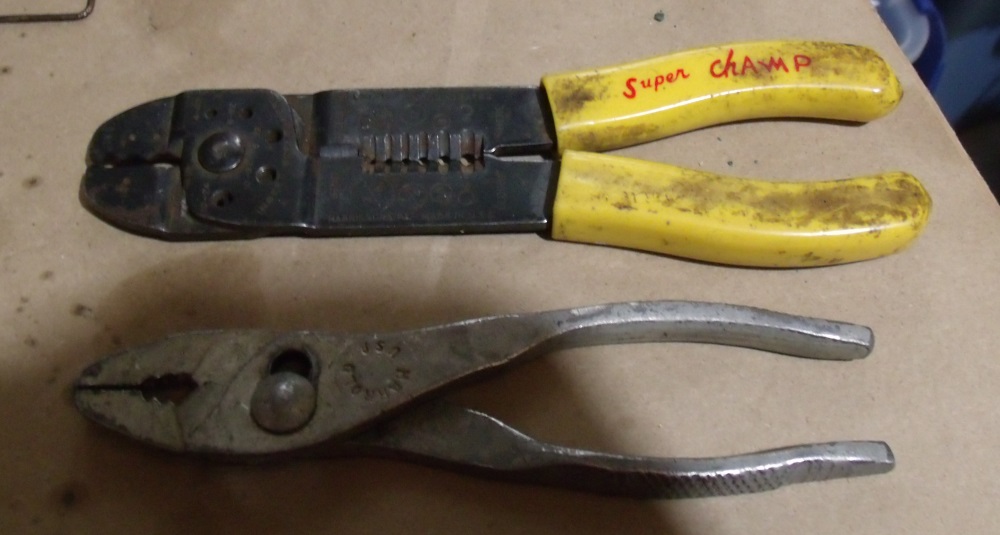


11. Crimp the terminal close to the end of the insulation sleeve that covers the stripped wire end.  You want the terminal to connect to the stripped wire, not the insulation.


Installing the Cord

12. Installation is the reverse of removal.  If you have space inside the controller, tie a knot in the wires to prevent them from sliding out through the exit hole.  Connect the two wires to the two terminals.  It makes no difference which wire goes to each terminal, a resistor can’t tell the difference which way current is flowing.


13. Route the wires so that they do not interfere with any moving parts and out through the exit hole, slot, or whatever is there.
14. Replace any loose parts you removed in step 4.
15. Replace the insulating pad, if your controller has one.
16. Replace the bottom cover.
17. Connect to your sewing machine and Sew!

Ed


Tuesday, October 20, 2015

Kenmore 385.1684180

Even though it has the slide plate that turns under the seam allowance, I really like my 385.17881 Kenmore because it is so smooth and quiet. 


I always consider those traits to be an indicator of the quality of the machine.  Unfortunately, when I got it, the stitch length dial was very difficult to turn and I tried to loosen things up with a heat gun, melting some teeth on the plastic gear behind the stitch length dial.  I was able to reposition the gear so that the missing teeth were  not where they would affect stitch length selection, but the dial still turns very hard and I only have stitch lengths of 10-12.  I have been looking for a replacement for that machine, hoping to find the exact model needing work so I could cannibalize parts from my current machine to rehab the new one.

I still haven't found the exact model replacement, but I saw this 385.1684180 on an online auction.


 The style lines are very similar to the 385.17881 and it has the same rotating hook and drop-in bobbin, so I bid on it, hoping it would be as smooth and quiet as the 385.17881.

When I received the 385.1684180, I saw that it appears to have been well-used, but not abused.  The light bulb was burned out and the plastic bushings that hold in both spool pins are broken.  Sears Parts Direct had the bushings in stock and they are on the way to me.  The bobbin area was very clean, making me think the machine had been well cared for, but when I opened the bottom covers, a lint ball the size of a plum fell out!  It had been cleaned from above, but never went in for a professional servicing.  There was also a lot of gummy substance on many of the surfaces underneath, including the hook gear.  I tried to clean it off with mineral oil, alcohol, and several other substances but scraping it off seemed to be the only way to remove it.

Those issues  were easy to fix but one was more difficult - it would not stitch in reverse.  Pressing the reverse button had no effect, it just kept going forward.  Tracing out the linkage from the Reverse button, I found that there are two springs and a collar that slides along the hook shaft. 


When the collar is to the right, the machine sews forward.  When the collar slides to the left, the feed dog travel is altered so the fabric feeds in reverse. 

Here's how it works:
    The spring near the Reverse button (not shown in these photos) is stronger than the spring down by the collar (in yellow circle).
    When the Reverse button is pressed, the weaker spring is allowed to slide the collar (in the red circle) to the left for Reverse.
    When the Reverse button is released, the stronger spring pulls the rod (in blue) and overrides the weaker spring and slides the collar to the right for forward sewing.

  I could feel that the collar was not moving freely and spent two days trying to free it up.  After lubing and exercising the collar and hook shaft for hours with no results, I accidentally knocked the arm from the weaker spring out of its track and found that the collar itself was actually free-moving, it was the arm from the weaker spring to the collar that was binding.  I had oiled the pivot point of that arm in the very beginning but that was not enough.  I removed the arm and spring, cleaned everything well and re-lubricated.  The Reverse button now works as advertised and the machine sews backward as well as forward.

 FORWARD

REVERSE
 
 
Ed


Thursday, March 05, 2015

Folded Seams

I have been having a problem occasionally with seams folding over as they run under the presser foot.  Not all the time, just some of the time.


I have linked this phenomenon to a specific feature of certain sewing machines,  This Kenmore 17881


 And this Riccar Super Lite


cause the folded-over seams but the Singer 403 and the Pfaff 1222 that I have used recently do not.

I think I have the issue pinpointed to the configuration of the throat plates.  The Kenmore and the Riccar have throat plates elevated a bit above the surrounding surface


while the Singer and Pfaff have throat plates level with the surrounding surface.


The elevated lip of the Kenmore and Riccar throat plates catches the seam allowance and pushes it back as the fabric feeds across the plate.  When a seam approaches the throat plate, I have to lift the fabric up and physically push the seam allowance where it belongs, then continue sewing.

Now that I know that, I will not use those machines for projects involving sewing over seams.

Ed
Ed's Vintage Sewing Machine Shop


Friday, August 01, 2014

Kenmore 1400

A few days ago, a friend gifted (cursed?) me with a Kenmore 158.14000.  Her daughter had bought it at a yard sale for the cabinet and did not want the sewing head.


The preliminary inspection told me that the machine had been stored in a high humidity area


 but in spite of the rust on the foot control, there was relatively little rust inside the machine itself.


My guess is that the machine was stored in a basement or garage, the cabinet held the sewing head suspended while the foot control sat for a considerable time on the concrete floor.

The next thing I discovered was the lack of a thumbscrew needle clamp. You have to use a screwdriver to change the needle.


Presser feet are also not held on via a thumbscrew, there is a little lever on the rear of the presser bar that loosens and tightens a screw to hold the presser feet.


This means that most presser feet do not fit but a general purpose foot came with the machine and I did manage to scrounge up two other feet that work.

One feature I find really neat is this little insert that sits in a groove in the needle plate.  You turn it one way for zig zag sewing, then turn it around the opposite way for straight stitching.


Saves having to remove the screws and change out the needle plate.

When I first tried to sew, straight stitch was perfect but zig zag would only make a stitch on one side. The most common cause of this problem is incorrect needlebar height.  At some time, the sewist hit a button or zipper and drove the needlebar up so that now, the needle is too high for the hook to catch the thread.  Needlebar height is easy enough to adjust, just loosen the clamping bolt on the collar, slide the needlebar to the correct position and tighten the bolt back down.


In order to see the hook point passing the needle eye, I need to remove the feed dog and I didn't have the proper tools with me so I just loosened the needle and dropped it down about 1/8 inch.  The result is the same as lowering the needlebar and zig zag works properly.  Now that I have verified that needlebar height is the issue, I will remove the feed dog and adjust the needlebar so that when the the hook passes the needle, the point of the hook is just above the top of the needle's eye at all stitch widths.

This model has a good selection of decorative and utility stitches but up to now, I have been unable to use them.


At first, I thought it might be operator error and visited the Sears website to download an operator manual.  When I enter the model number of this 1400, the site returns a manual for a model 14 - a completely different machine.  I did find a manual for a 1430, which is close, but not identical. Turned out that it wasn't operator error after all, there is one lever inside the vertical pillar that locks the cam follower in place when a stitch is selected. The cam follower position nearest the operator (where it is in the photo) is zig zag.


 That lever is sticking so that when a decorative stitch is selected, the sticking lever allows the cam follower to move away from the operator, but does not allow the cam follower to return in the opposite direction.  To move the cam follower back to zig zag, I have to remove the lid and push the lever into position with a screwdriver.  I have used sewing machine oil and Liquid Wrench so far but neither had much effect.  I am contemplating installing a spring on the lever to "help" it into its proper position.  Until I figure out a remedy, the machne is permanently in zig zag.  Stitch width '0' gives me a straight stitch and that and zig zag is all I really need for the sewing I do.

Ed
Ed's Vintage Sewing Machine Store

Friday, May 23, 2014

Kenmore 1720

  Last week, a lady called having a problem with her Kenmore Ultra Stitch 12.  When I went to pick it up, she had a second machine belonging to a friend, a Kenmore 1720.


  She said there was nothing wrong with it, it just needed cleaning and oiling.  The machine looks very well cared for and little used but it had a very loud clanking sound when operated.  Except for that noise, the machine ran smoothly and, with the bobbin case /shuttle removed, very quietly so I was pretty certain where the noise was originating from.  I opened up all the panels and oiled everything and, while doing that, found some thread wrapped around the knuckle of the thread take-up lever.

 
  Here's where it gets goofy - AFTER I removed the thread, the machine locked up so tight that the motor wouldn't turn it over and it was difficult to rotate by hand!  I looked for additional thread clogs and re-oiled evrything with no improvement. To isolate, I disconnected the connecting rod that transmits movement from the main shaft to the lower section.


  This cuts the mechanism in half and tells me whether the problem is in the upper or lower section.  It was in the upper section.  Having exhausted all my ideas, I doused the whole upper section with Liquid Wrench and let it sit overnight.  This morning, it seemed a bit looser turning by hand and, after a few revolutions, the motor took over and spun the shaft. I ran in the machine at top speed for about a minute and all the binding is gone.  I have no idea where the problem was.

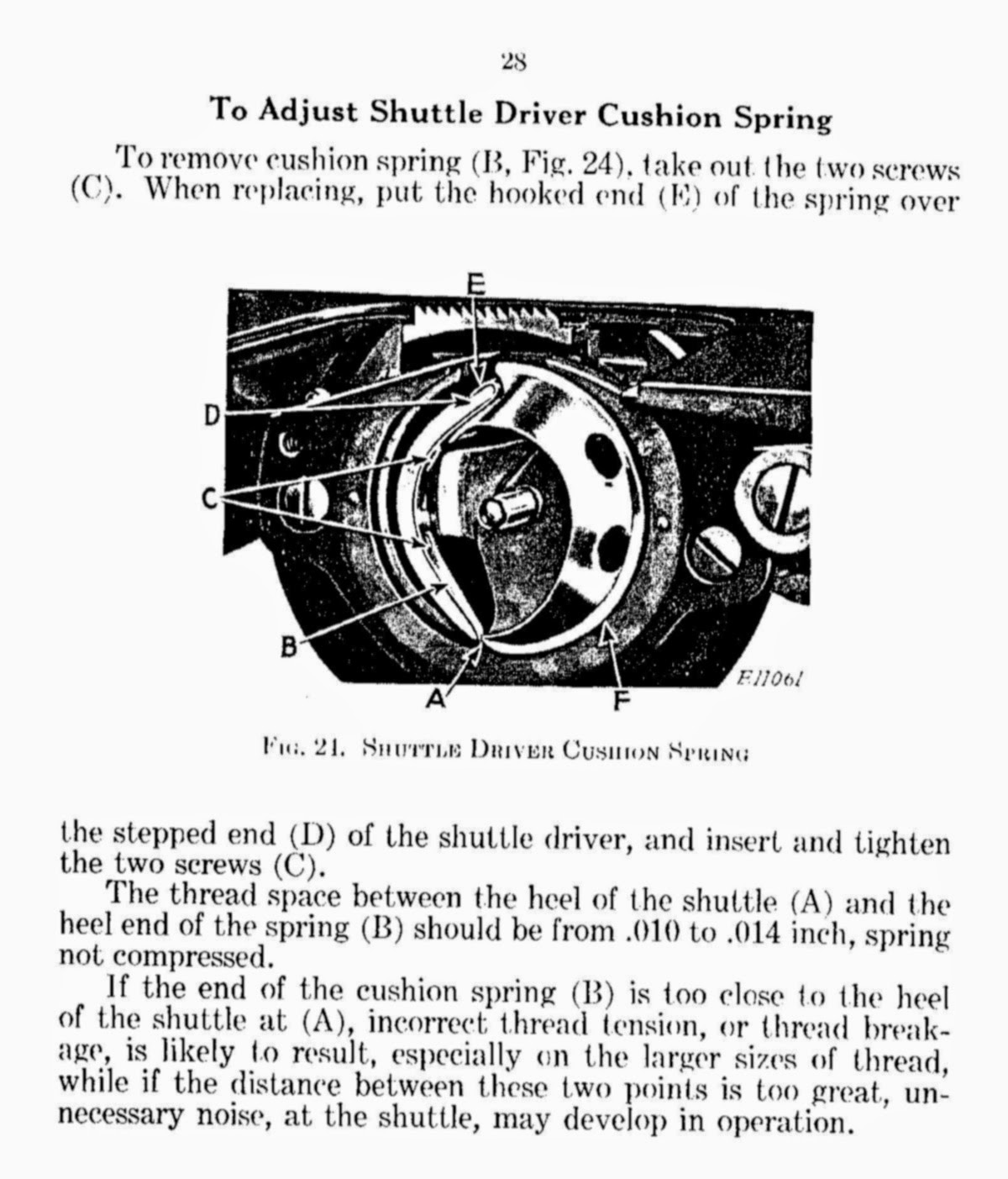
Then on to the noise in the shuttle area.  The thread gap between the tip of the shuttle cushion spring and the shuttle should be just over the thickness of thread but this one was a good 1/8 inch.

  That explains the noise!  I went to bend the cushion spring to narrow the gap and found that there was no end - the end of the spring had broken off.


I rummaged through all my parts bins and could not find a single cushion spring. Apparently, that is something that needs replacing so seldom that I haven't kept any spares.  Then I remembered the Julia I am parting out still has the cushion spring so I cannibalized it but it is too long to work in the Kenmore.  Fortunately, my parts source has the springs and attaching screws in stock, so I can order replacements.

Ed
Ed's Vintage Sewing Machine Shop