Showing posts with label Singer 404. Show all posts

Tuesday, January 19, 2016

Singer 500a Will Not Form Zig Zag Stitch


To keep all my old sewing machines limber, I like to take them off the shelf occasionally and use them on a project.  I really should tag each machine to tell me when was the last time it was oiled and used but I’m just too lazy.  Anyway, I pulled this Rocketeer off the shelf, oiled it and tested the stitches.  I have no idea how long it had been sitting unused, maybe years.

Straight stitch was fine


but wide zig zag was not. 


I narrowed the stitch width and it got a wee bit better, but still not in the acceptable range.


My first thought was that the needle bar had been shoved up in its clamp by hitting a button or zipper but the marks on the needle bar were in the correct position so I knew that was not the cause.


The next thought was hook timing.  The point of the hook should pass just above the eye of the needle when the lower timing mark on the needle bar is at the needlebar bushing.  It was, so that was not the issue.


When I was watching the hook pass by the needle, I noticed that there seemed to be a more-than-usual separation between the needle and the hook point.  The service manual says that distance should be .018 inches but I measured it at .032 inches – almost twice what it should be.


To be sure that the needlebar was not bent, I installed a size 18 needle and a straight stitch needleplate and checked where the needle passed through the hole in the needleplate.  It looked just like the drawing in the service manual, so the needlebar was not bent.

The next step was to move the hook closer to the needle.  The service manual says to loosen the two setscrews indicated by "O"
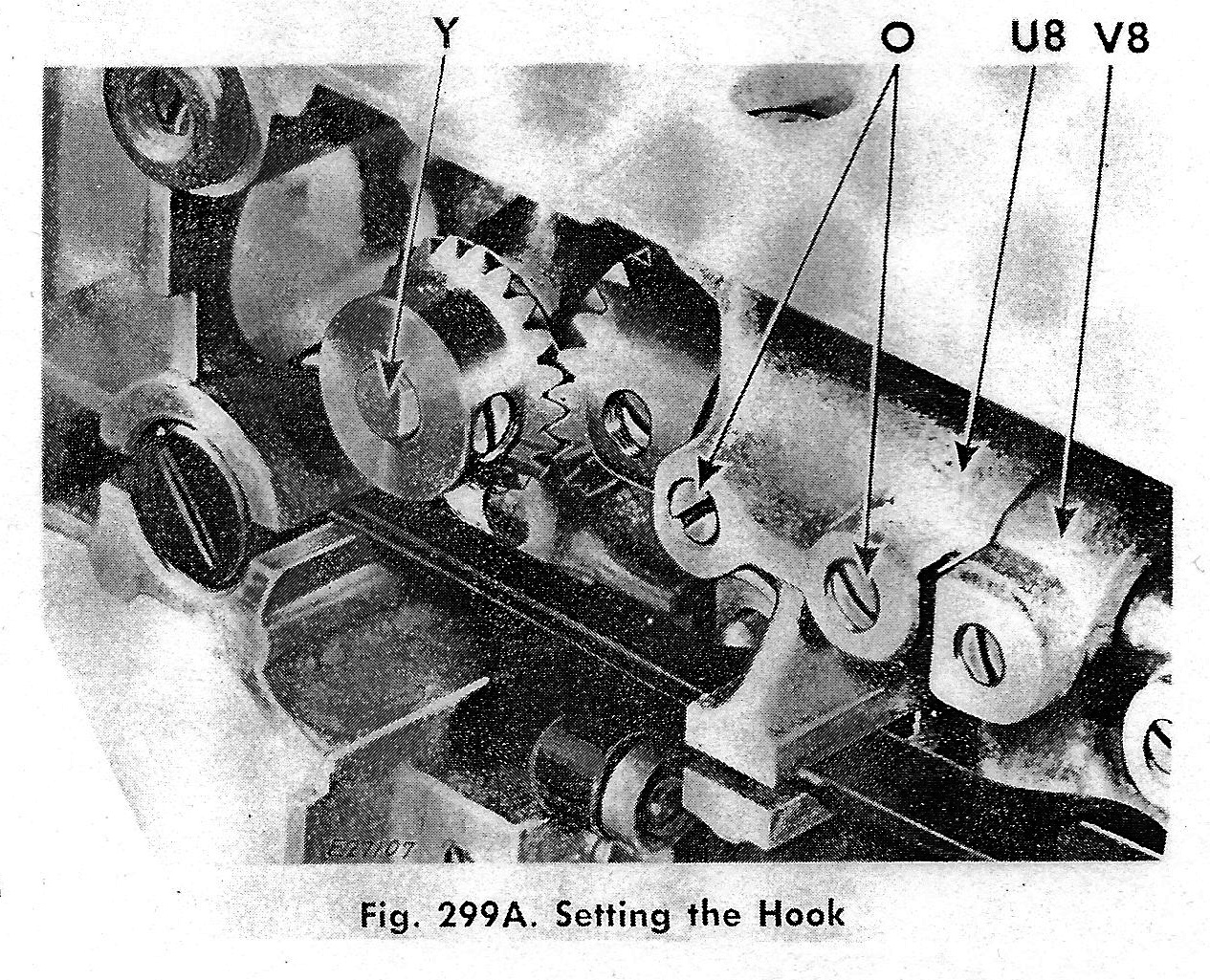
And move the entire hook saddle.  It was easy enough, after loosening the two screws, the hook saddle swivels around the shaft it is mounted on and the hook point can be moved closer to or farther from the needle.  I moved the hook as close to the needle as possible without hitting it and tightened the screws.

I now still have good straight stitch and the narrow zig zag is as it should be.


I am not getting the full width zig zag that the machine is capable of, but that is a different problem that I will tackle later.

 Ed


Sunday, September 07, 2014

Singer 401/403/404 Tension Adjustment

Today I dug out a Singer 403 that I haven't used in a long time (maybe never).


I'm not sure I ever serviced this machine when I got it because there's some tape residue on the vertical pillar that I would've cleaned off if I had ever cleaned and oiled The machine.

As I was sewing on my project, I noticed suddenly I was getting loops on the underside of the fabric. It had me stumped for a minute until I saw that my upper tension dial was at zero. The tension knob was so loose that just the slightest bump moved it from its desired setting.

As I was getting ready to correct that situation, it occurred to me that maybe some others would like to know how that's done so I got the camera out and took some pictures of the process.

  There are many styles of tension assemblies, this is the one used on the Singer 400 series. Once you get the external knob off, you find that all upper tension assemblies are very similar inside.

Here is a clip from the service manual telling how to disassemble the 401/403 tension assembly.  To merely tighten the knob, you only need to perform these two steps.


After the thumb nut L5 is removed and the split stud is exposed, insert the blade of a flat screwdriver in between the two halves of the split stud Q2 and spread the two halves slightly apart. That will tighten up the thumb nut L5 when you screw it back on.


If you get the stud halves spread too far apart and the thumb nut L5 will not go back on, squeeze the stud halves back together a bit with pliers and try again until you get it where you want it.

 I had previously noticed that the +|- indicator was skewed off to one side so while I had the tension assembly open, I thought I would fix that also.


There is a set screw inside the nose door that holds the entire upper tension assembly in the machine. Loosen that set screw and you can turn the assembly to any position you desire. When you have it where you want it, tighten that setscrew and you're ready to reassemble.


Assembly is the reverse of disassembly.

After the tension assembly is reassembled, you want to adjust the tension so that you have a good balanced stitch with no regard to the numbered dial.

Once you have a good stitch, push in the numbered disc D5 and rotate so that the number 4 appears at the top of the dial at the +|- indicator. Release the numbered disc and make sure the pin C5 is seated in one of the holes in D5 and you're done.


Ed