Wednesday, August 27, 2008

Singer Online Manuals


I thought I would share my list of sources for online instruction manuals and service manuals. I clicked all these links today to make sure they are still active, doesn't mean they will be tomorrow! These are links to Singer manuals, next time I will dust off my links to other manufacturers.

Ed

INSTRUCTION MANUALS
Singer No. 15
http://www.sil.si.edu/DigitalCollections/Trade-Literature/Sewing-Machines/NMAHTEX/0203/
http://www.sil.si.edu/DigitalCollections/Trade-Literature/Sewing-Machines/NMAHTEX/2664/
http://www.parts.singerco.com/IPinstManuals/15.pdf
---------------------------------------------------------------------
Singer 15K
http://www.parts.singerco.com/IPinstManuals/15K.pdf
--------------------------------------------------------------------
Instructions for using Singer sewing machines 15-88 and 15-89
http://www.sil.si.edu/DigitalCollections/Trade-Literature/Sewing-Machines/NMAHTEX/2665/
-------------------------------------------------------------------
Instructions for using Singer Sewing Machine 15-91
http://www.ismacs.net/singer/manuals/15-91.pdf
------------------------------------------------------------------
Instructions for using Singer sewing machines of class 24 one needle single thread chain stitch for manufacturing.
http://www.sil.si.edu/DigitalCollections/Trade-Literature/Sewing-Machines/NMAHTEX/2670/
-----------------------------------------------------------------
Singer Sewing Machine No. 27. / Vibrating shuttle number 2.
http://www.sil.si.edu/DigitalCollections/Trade-Literature/Sewing-Machines/NMAHTEX/0673/
-----------------------------------------------------------------
Singer 99k
http://www.parts.singerco.com/IPsvcManuals/99K.pdf
----------------------------------------------------------------
Instructions for using Singer sewing machine no. 115
http://www.sil.si.edu/DigitalCollections/Trade-Literature/Sewing-Machines/NMAHTEX/2682/
---------------------------------------------------------------
Singer 127 & 128 manual
http://www.ismacs.net/singer/manuals/127-128.pdf
http://www.sil.si.edu/DigitalCollections/Trade-Literature/Sewing-Machines/NMAHTEX/0650/
http://www.sil.si.edu/DigitalCollections/Trade-Literature/Sewing-Machines/NMAHTEX/2678/
---------------------------------------------------------------
Instructions for Using Singer Sewing Machine 195k / http://www.parts.singerco.com/IPinstManuals/195K.pdf
----------------------------------------------------------------
Instructions for using Singer Sewing Machine 201
http://www.ismacs.net/singer/manuals/201.pdf
---------------------------------------------------------------
Instructions for Using Singer Sewing Machine no 206
http://www.sil.si.edu/DigitalCollections/Trade-Literature/Sewing-Machines/NMAHTEX/2983/
--------------------------------------------------------------
Instructions for using Singer Sewing Machine no. 301
http://www.ismacs.net/singer/manuals/301.pdf
-------------------------------------------------------------
Instructions for using Singer Sewing Machine no 404
http://www.ismacs.net/singer/manuals/404.pdf
-------------------------------------------------------------
Instructions for Using Singer Sewing Machine no 431
http://www.ismacs.net/singer/manuals/431.pdf
------------------------------------------------------------
Instructions for Using Singer Sewing Machine no 503
http://www.ismacs.net/singer/manuals/503.pdf
------------------------------------------------------------
SERVICE MANUALS
------------------------------------------------------------
Service Manual Singer 66, 99, 185. /
http://www.parts.singerco.com/IPinstManuals/66.pdf
Adjuster's Manual Singer 15-91
http://www.parts.singerco.com/IPinstManuals/15-91.pdf
Adjuster's Manual for Singer 206k25 /
http://www.parts.singerco.com/IPsvcManuals/206K25.pdf
Swing Needle Service Manual Models 306, 319, 401
http://parts.singerco.com/IPsvcManuals/306W25.pdf
Service Manual for Models 620, 625, 626, and 628
http://www.parts.singerco.com/CPpartCharts/6_6999/620_625_626_628.pdf

Tuesday, August 26, 2008


I have cruised eBay for many years, researching and buying sewing machines. About once a year, a smaller version of a Japanese 15 Class machine shows up. They usually have cutesy names, like Margaret or Princess and they usually sell for about $75 – much more than a standard size 15 Class machine (and more than I am willing to pay). Last week, I noticed one that did not have a cute name and the dimensions were not noted in the description, but looking at the rear view, the motor seemed considerably larger than normal and the proportion of the throat area seemed odd. Not wanting to ask a question and tip off other bidders, I bid what I considered was a reasonable amount and ended up the only bidder at 99 cents! Shipping brought my total to just under $18.


UPS delivered it yesterday. The length of the bed is 12”, compared to a standard bed of 14”. The space from needle to vertical pillar is 5.75”, compared to 7” on a full size machine. Other than that, everything seems to be normal size, except the length of all the shafts. After cleaning and oiling, it runs smooth, but I haven't gotten around to installing a spool pin to test stitch. I will need to manufacture a base for it – it won't fit in a standard base or cabinet. Before I do, I will try it in a ¾ size carrying case from a Singer 99.

Tuesday, February 19, 2008

You Can Use Vintage Sewing Machines!

Earlier this month I was packing for a trip to Japan. I couldn’t find the shoe bag I made years ago and didn’t want to put my shoes in a plastic Wal-Mart bag, so I decided to whip up another shoe bag. While I was rummaging through the box of scrap fabric, I noticed a pair of my wife’s discarded jeans. It seemed that the bottom of each leg might make a bag large enough for one shoe. Measuring the shoes I wanted to pack, I cut off 18" of the lower end of each pant leg.


I worked the rest of the project with the denim tube inside out. You can’t see it in this photo, but I tucked in about an inch on each side and sewed across the bottom of each leg.


I opened about 1.5" of the seam in the upper edge of the tube to make an opening for the drawstring and sewed down the two seam allowances.


Next, I sewed a ¾" tunnel for the drawstring and inserted the string.


Turning the bag right side out, it is finished.


Using a higher section of the leg, you could make one bag large enough to hold two shoes, but I thought it might be easier to pack a pair of shoes if they could be tucked into two separate corners of the suitcase. Just to keep this on the subject of vintage sewing machines, I sewed this project on my Singer 111W155 compound feed upholstery machine. That monster made quick work of those denim seams.


I traded an 8-track player for this machine in the early 70's. I had it professionally rebuilt for $295 and have used it for about 35 years now with no further repair. I expect it to last me the rest of my life.

Sunday, January 27, 2008

Quit Needling Me!


There has been more than the usual chatter on the sewing forums lately about needles. It seems that very few sewers know
anything about needles and the few who think they do are merely repeating urban myths that they heard from some questionable
source. I decided to perform some research and publish my results here. Before sewing machine and sewing forums sprang up on
the internet, I had a very limited knowledge of sewing machine needles. Thanks to folks like Bill Holman, who are willing to
share their years of experience, I learned enough to be dangerous, but still keep hearing stories about one brand of needle
being better than another, or one brand being longer than another so they won't work in certain machines. I dug through my
needle stash and pulled out samples of widely-used needles and put them on my scanner at high resolution to see what the
difference really is. I started this exercise with the preconceived notion that standard 15x1 needles are all manufactured to
the same specification, so they all had to be identical, and all the hype about one brand being better than another was just so much hogwash. I do know that there are different styles of needles - sharp, ball point, leather, etc., and some needles are manufactured a little off-center to aid in sewing knits, but a ball-point Schmetz should be identical to a ball point Singer, right?.

The usual argument is that Singer needles are a bit longer than Schmetz and, for some reason, that makes the Schmetz needles sew better. I took needles made by Schmetz and Singer and carefully lined them up on the glass of my scanner. I tossed in an Organ needle, too, because that's the brand I use most and wanted to see how Organ compares to the other brands. I also
have a box of very old Singer needles and tossed one of them in the mix to see how needles have changed over the years.

In the photo, the Schmetz and new Singer are the two center needles, the Singer being identified by the red shaft. The Organ needle is on the left, and the vintage Singer needle is on the right. I used a straight edge to align the shafts and found that all the stories I had heard about Singer needles being longer than Schmetz are all hot air - both modern needles are the same length. Additionally, the distance from the top of the shaft to the top of the eye (the critical distance for timing) is the same on all four. The distance from the eye to the point of the Organ needle was just a tad shorter than both the Singer and Schmetz, as was the vintage Singer needle. The eye of the vintage Singer needle is roughly half the size of the eye of all the modern needles, and the vintage Singer needle has no scarf.

Here are my conclusions:

- Modern Singer and Schmetz needles are identical.
- Of the three brands, no one modern needle appears to be better than another.
- Organ needles appear to be identical to Schmetz and Singer, except that the distance from the eye to the point is shorter. If you like Schmetz, try Organ at one-third the price and see if you can tell the difference.
- If you still have some old needles in the drawers of Grandma's treadle, you might be better off replacing them with modern needles. At least, save them to use with the older machine and don't "borrow" them for your new, computerized machine.

Wednesday, January 03, 2007

Wanna Necchi?

I'm back after an extended period in which Blogger would not recognize my password and would not acknowledge multiple "forgot my password" pleas. I finally regained access by telling Blogger "I forgot my user ID". Maybe I will have better luck with the new Blogger?


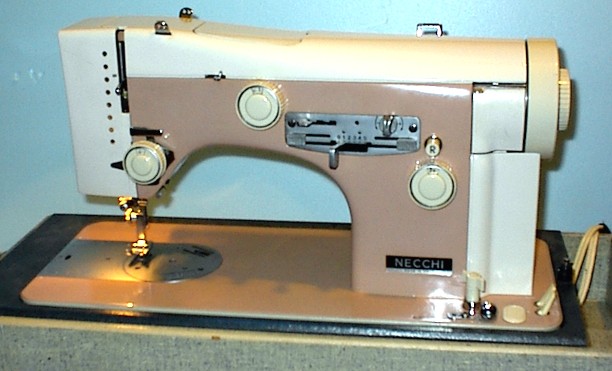
Before I became hooked on industrial machines, my favorites were Necchis. Necchi was one of the first, if not the first, to introduce zig zag machines to the home sewer and the Supernovas of the late 1950s had decorative stitch capabilities that did not show up on most other manufacturers' machines for another decade. All you have to do is sew a short seam on a Supernova to know immediately that all the parts are flawlessly machined and fit together properly. The rotation of the balance wheel is smooth as silk and the machine doesn't make enough noise to wake a sleeping cat. Unfortunately, this precision comes at a price - there is so little space for oil between the moving parts that Necchis must be frequently lubricated to maintain their efficiency. The needlebar swivel on the zig zag models is a particularly sensitive to lack of lubrication and will freeze up tight if ignored for too long. Probably half the Necchis I have acquired had frozen needlebar swivels which took hours of oiling and persuading to get them moving freely again. I suspect this is the reason that many sewers abandoned their Necchis, the American and Japanese models of the time could sew for months or even years without being oiled.

Necchi has passed through several phases, but the machines made in Italy before the Age of Plastic are, in my opinion, the best-engineered and most well-built sewing machines ever made. The models that fit in this category are the BF, BU, Mira, Nora, Lelia, Supernova, and Lycia. Some of my Necchi collection can be seen at http://www.geocities.com/lamx . Beginning with the Lydia, Necchi began experimenting with plastic gears and camstacks that have disintegrated over time and need to be replaced. A replacement plastic Lydia camstack costs over $100 - about 4 times what the machine is worth on the open market. Sometime in the 70's, Necchi started having machines made in Japan and quality declined somewhat. The Japanese Necchis are okay, but not built to the same high standards that the Italian models enjoyed. After a short time using Japanese manufacturers, Necchi moved production to Taiwan and changed from selling sewing machines to boat anchors. I can't even comment on modern-day Necchis.

Wednesday, June 21, 2006

Industrial Sewing Machines


The main difference between industrial machines and family-use machines is that industrial machines are designed to perform ONE task and perform it very well. Family-use machines are designed to do everything and as a result perform some tasks inadequately. A perfect example is buttonholes - read all the postings on various forums complaining about the poor quality of buttonholes formed on family-use machines, then look at any item of commercially produced clothing and see what the buttonholes look like. The machine that made those buttonholes will do nothing but sew buttonholes 16 hours a day, 5 days a week, but don't try to use it to install a zipper! The vast majority of industrial machines are straight stitch only because that's the kind of sewing that's performed most in factories. What you lose with the household machine is the strength, speed, and consistently perfect stitches obtained with an industrial sewing machine. In most cases, the industrial sewing machine has two distinct parts: the sewing machine itself, and the power stand, consisting of the table and motor. Most manufacturers recommend that a one-half horsepower 3450 rpm or 1750 rpm motor be used on their machines. Using this powerful motor, the machine can achieve a fast sewing speed by using pulleys. On some industrial machines you can achieve a sewing speed of 4500 spm (stitches per minute) or more. Family-use sewing machines have their motors attached to the body of the machine. The motors are usually rated at one-tenth horsepower. The power is limited because of the motor size, so they use a pulley or gearing system to increase the power while producing a slower stitch speed. Most household sewing machines sew at 800 spm.
Sometimes terms like "semi-industrial", "heavy duty", and "industrial strength" are used to imply that a household sewing machine has the power of an industrial. In these cases, the buyer should verify the actual motor power and stitching speed. That said, the Brother 1500 series and Juki 98 series are straight stitch machines possessing some of the features of home machines, like needle threaders and thread cutters. Their throats are slightly larger than standard family machines, making them popular with quilters who are unwilling to upgrade to a true industrial machine. The Bernina 950 probably has the most features on a "semi-industrial" - 21 stitches, 5-step buttonhole, and the 1/2 hp motor will drive it to form 2000 stitches per minute but throat area is no larger than a home machine. At around $1700, that would be my choice if I wanted a bunch of functions combined in one ruggedized machine. However, for the same money, I would buy a used straight stitch industrial ($250), a used zig zag industrial ($600), and one other specialty machine, depending on the sewing you do (buttonholes, grommets, quilting). As for reliability, the major brands are probably best, Pfaffs, Jukis, Brothers and the older Singers are the ones I have used.

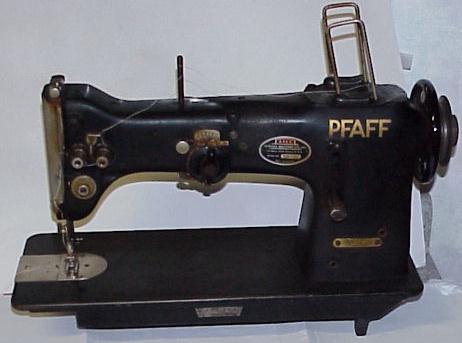
If you are looking at a used machine, check the price of any needed parts before buying. I bought a used Pfaff 144 double-needle machine that was missing the feed dog. Knowing that feed dogs for Singers cost in the neighborhood of $20, I willingly gave the $135 for the Pfaff. When I went to order a Pfaff feed dog, the dealer gave me a quote of $695 for just the feed dog! He told me I was lucky I didn't need a throat plate too, because that would add another $350! I have never owned an Adler, but hear that replacement parts for them are similarly priced.

Tuesday, May 09, 2006

Presser Feet

Mary Jo asks, "A friend has a White 999 and wants a walking foot…I've tried to explain to her about checking the alignment of the feed dogs and checking the shank, anything else she should check?". While I don't intend to use the blog to answer individual questions, this might be an opportune time to start a thread about presser feet, because they cause a good deal of stress for new users of vintage machines. I am certainly not a fountain of presser foot knowledge, I'll just spout out what I know and invite anyone else to jump in and add more info or correct any misstatements I might make.
------------------------------------------------------------------
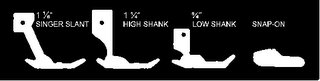
While there are quite a number of different sizes, shapes, and styles of presser feet out there, the vast majority manufactured since the turn of the 20th Century fall into 3 1/2 categories:


- High Shank - Used on most industrial sewing machines and on Japanese zig zag machines of the 60's and 70's. Necchi machines of that era used high shank attachments on zig zag models and low shank attachments on straight-stitch models. If you have a high shank machine and are having problems locating suitable and economical presser feet, check with an industrial machine vendor. You'll be amazed at the huge variety of feet available.

- Slant Shank - Used on Singer machines made in the USA, Germany, and Japan in the 50's, 60's and 70's. Singer introduced the slant shank on the model 301 in 1950 and continued through all of the Slant-O-Matics, Touch 'n' Sew series and beyond. Interestingly, the Singers manufactured in Great Britain during the same time period continued using low shank accessories.

- Low Shank - probably the most common.

- Snap-On - I call this the 1/2 category because the snap-on adapters I have seen are low shank.
---------------------------------------------------------------------------------
Berninas use exclusive Bernina style attachments that will not interchange with anything else. This keeps the price of Bernina accessories high and is reason enough for me to stay away from Berninas unless they come with a full complement of presser feet and other attachments.

For a short time, Sears used a "Super High Shank" style presser foot on their Kenmores, probably for the same reason that Bernina uses exclusive feet - to stifle competition.

For a few years, Singer used back-clamping feet on the model 66, but later switched to low shank feet. Back-clamping feet are a bit scarce, but it is a simple job to swap the presser bar from a later model 66 and begin using low shank attachments.
---------------------------------------------------------------------------------
The general wisdom is that you may swap feet between different machines as long as they are the same style (High Shank, Slant Shank, etc.). While this is basically true, there are some considerations:

- The feed dog on a zig zag machine is wider than the feed dog on a straight stitch machine. If you try to swap a straight stitch foot to a zig zag machine, or vice-versa, the feed dog might not align properly with the underside of the foot and fabric will not feed properly.

- The needles on early zig zag machines were not centered, as they are today, they rested in the left side of the needle hole in the throat plate. If you try to swap a straight stitch foot between center-needle machines and left-needle machines, the needle will hit the foot and break. Usually the zig zag feet are still swappable because the hole in the foot is wide enough to accept the needle all the way from full left to full right throw.

The Clotilde catalog has a chart crossing machines to the style of presser foot at:
http://www.clotilde.com/cl/shank_chart1.asp
I spotted at least one error in the Necchi section, but it might help somewhat.

There you have it - the sum total of my presser foot knowledge! Comments?

Thursday, May 04, 2006

Japanese Clones of the 40's, 50's, and 60's

Shortly after W.W.II, Japan, with money from the United States, manufactured a large number of sewing machines. The most common of these were based on the Singer Model 15 but there are also Singer 99 clones. Indeed many of these machines are practically indistinguishable from a Singer and use parts that are interchangeable. Often they were given American sounding names to appeal to the overseas market. Over 5000 different "brands" have been identified, manufactured by 15 or so companies. Unfortunately, records from these manufactures don't exist, so it is impossible to identify them further. Generally speaking, a machine will, somewhere, state "made in Japan" or have "JA- " stamped into the bottom of the machine. To further complicate matters, large retailers would purchase machines and have the company name on them: RH Macy, Gimbals, etc. Any retailer so inclined could have Sewing Machines made just for him or her (Sears Kenmore, Wards Signature). I've tracked Department Stores, Machines with Automobile names, female names, patriotic names etc. The post war machines are generally well made, often quieter and smoother running than the Singers they were copied from! Japan also gave us many of our colored sewing machines. Examples have been found in metallic blue, green, pink, yellow, and I have a Fire Engine Red one! In terms of collectability, don't be fooled by a claim of "an extremely rare" Mitsubishi, Ford, Saxon, Stitch Queen etc., the same machine could have dozens of different names. If it says "Singer" on the machine, it probably is. If it doesn't, it's not. The Japanese machines have not caught on with collectors (even the ones made in Occupied Japan) and as a result retain very little value. They can be found at many thrift shops for $10-$20 and at local auctions for under $5. This might be a good niche for a collector on a limited budget – they could collect all pink machines or one machine of each color.

Tuesday, April 25, 2006

The Beginning


Collecting Antique and Vintage sewing machines is a growing hobby. Some collect just because they are beautiful to look at. The time, effort, and expense expended in decorating these mechanical marvels with gold, green, and red decals is something that is unseen in this day and age. Others collect sewing machines because they marvel at the precision mechanism and the inherent reliability. A 100-year-old sewing machine in good repair will still function today and make a straight stitch to rival the newest computer operated machines. Still others buy old sewing machines to use in day to day sewing. They may enjoy the feeling of sewing without benefit of electricity on a treadle or handcrank machine or they may just enjoy sewing for extended periods without experiencing breakdowns common to modern plastic sewing machines.
Regardless of the reason you buy old sewing machines, it helps to know how they work and how to maintain them. This is more difficult than it should be because there is very little consumer information available on old sewing machines. Instruction books can be tough to locate for many models; the handful of repair books I have found were published in the 1970s and before, are complicated and incomplete. Sewing machine dealers and repair shops have service manuals, but they guard them jealously and you will have a difficult time talking your local dealer into copying one for you. In the last couple of years, the Internet has spawned some sites where antique and vintage sewing machines are discussed and parts are swapped. If you can find those sites, you will learn more about old sewing machines there than from any other single source.
This blog is my attempt to help the antique and vintage sewing machine buyer to select and maintain an all-metal machine.